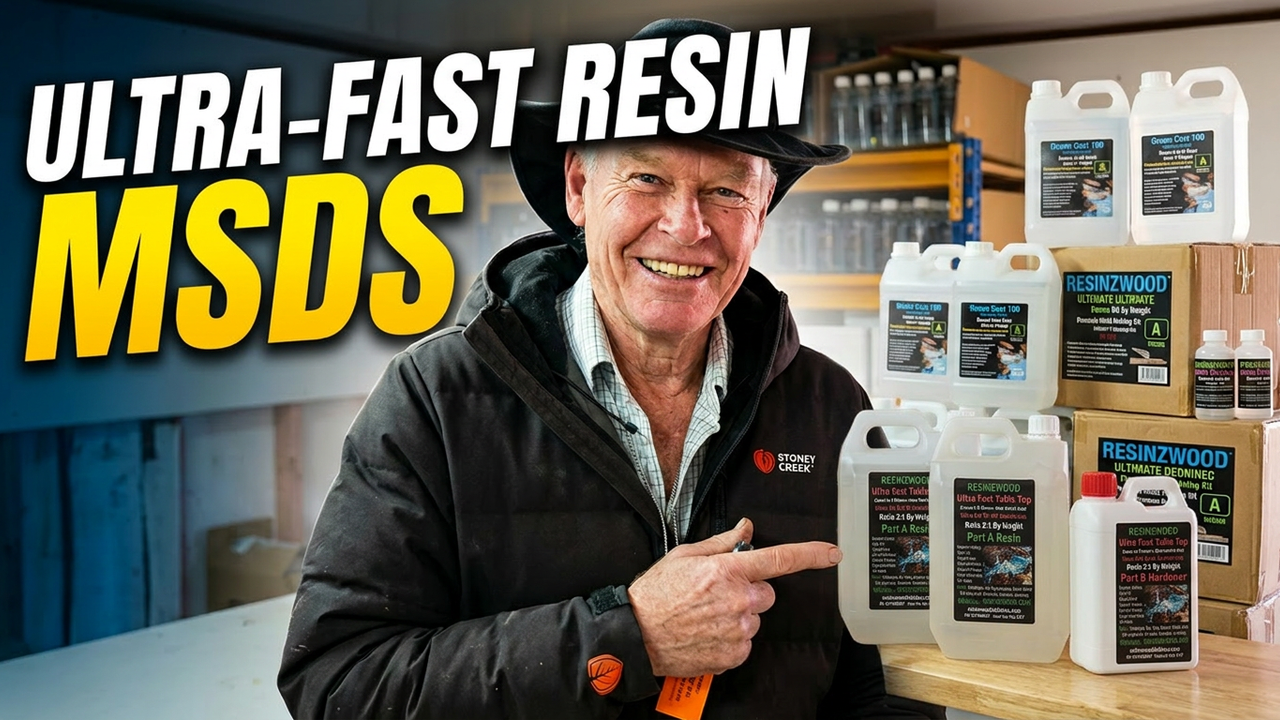
Ultra-Fast Resin MSDS - FDA & EU Approved
Resinzwood Limited Safety Data Sheet
PRODUCT: Resinzwood Ultra-Fast Part A (uses: high build glaze on timber)
FDA – UE Approved
Manufacturer: Resinzwood Limited
Address: Head Office 410 Linwood Avenue Bromley Christchurch
Emergency Contact:
NZ NaƟonal Poisons InformaƟon Centre 0800 764 766
2.HAZARD IDENTIFICATION
GHS ClassificaƟon:
-Acute toxicity Oral Category D (6.1D)
- Acute toxicity InhalaƟon Category E (6.1E)
- Skin sensiƟzaƟon: Category1 (6.5B)
-Corrosive Dermal Category B (8.2B)
- Corrosive Ocular Category A (8.3A)
- Chronic aquaƟc toxicity: Category2 (9.1A)
GHS Label Elements:
Hazard Symbols Signal Words -Danger
Hazard Statements.
-H302 Harmful if swallowed.
- H315 Causes skin irritaƟon
- H317 May cause an allergic skin reacƟon
- H319 Causes serious eye irritaƟon
-H333 May be harmful if inhaled
- H410 is Very Toxic to aquatic life with long-lasting effects
PrecauƟonary Statements
1. Prevention
- P260 Do not breathe dust/fume/gas/mist/vapors/spray*
-P270 Do not eat, drink, or smoke when using this product.
- P264 Wash hands thoroughly after handling.
- P272 Contaminated work clothing should not be allowed out of the workplace.
- P273 Avoid release to the environment. - P280 Wear protective gloves/protective clothing/eye protection/face protection
2. Response
-P301+P312 P330 P331 IF SWALLOWED, call a POISON CENTER or doctor/physician if you feel unwell. Rinse mouth. Do not induce vomiting.
-P304+P312 IF INHALED Call a POISON CENTER or doctor/physician if you feel unwell. -P340 Remove to fresh air and keep at rest in a position comfortable for breathing. -P303+P361+P3535 IF ON SKIN: Remove/immediately remove all contaminated clothing. Rinse skin with water/shower
- P305+P351+P338 IF IN EYES: Rinse cautiously with water for several minutes. Remove contact lenses, if present, and easy to do. Continue rinsing.
-P321 Specific treatment
- P333+P313 If skin irritation or rash occurs: Get medical advice/attention. - P337+P313 If eye irritation persists: Get medical advice/attention.
- P362 Take off contaminated clothing and wash before reuse. - P391 Collect spillage.
3. Storage
-not applicable
4. Disposal - P501 Dispose of contents/container following local/ regional/ national/international regulations
3.COMPOSITION/INFORMATION ON INGREDIENTS
Chemical Name CAS number Content % 2,2-Bis(4'-glycidyloxyphenyl) propane 1675-54-3 >60% Oxirane, mono[(alkyl(C=12-14)oxy)methyl] derives 68609-97-2 1 - 5% Formaldehyde polymer with (chloromethyl)oxirane 9003-36-5 5-10% and phenol
C9branchedalkylphenol 84852-15-3 1-5 % Bisphenol A epichlorohydrin polymer 25068-38-6 10-30%
4. FIRST-AID MEASURES
A. Eye Contact
Do not rub your eyes. Immediately flush your eyes with plenty of water for at least 15 minutes and call a doctor.
- Go to the hospital immediately if symptoms (flare, irritation) occur.
- Remove contact lenses if worn.
B. Skin Contact
- Flush skin with plenty of water for at least 15 minutes while removing contaminated clothing and shoes.
- Go to the hospital immediately if symptoms (flare, irritation) occur.
- Wash thoroughly after handling.
- Chemical burns must be treated promptly by a physician.
- Wash clothing before reuse.
C. Inhalation Contact
Remove the victim to fresh air and keep them at rest in a position comfortable for breathing. If breathing is absent, irregular, or respiratory arrest occurs, artificial respiration or oxygen should be provided by trained personnel. It may be dangerous to the person providing aid to give mouth-to-mouth resuscitation. If unconscious, place in the recovery position and get medical attention immediately. Maintain an open airway. Loosen tight clothing such as a collar, belt, or waistband.
D. Inges Ɵon Contact
Get medical attention immediately. Wash out mouth with water. Remove dentures, if any. Remove the victim to fresh air and keep them at rest comfortably for breathing. If the material has been swallowed and the exposed person is conscious, drink small quantities of water. Stop if the exposed person feels sick, as vomiting may be dangerous. Do not induce vomiting unless medical personnel instruct it. If vomiting occurs, the head should be kept low so that vomit does not enter the lungs. Chemical burns must be treated promptly by a physician. Never give anything by mouth to an unconscious person. If unconscious, place in the recovery position and get medical attention immediately. Maintain an open airway. Loosen tight clothing such as a collar, belt, or waistband.
E. Delayed and immediate effects and also chronic effects from short and long-term exposure
-not available
F. Notes to Physician
- Notify medical personnel of contaminated situations and have them take appropriate protective measures.
FIREFIGHTING MEASURES
A. Suitable (Unsuitable) extinguishing media
- Dry chemical, carbon dioxide, regular foam extinguishing agent, spray
- Avoid the use of water jets for extinguishing
B. Specific hazards arising from the chemical
-Not available
C. Special protective actions for firefighters
- Withdraw immediately in case of rising sound from venting safety devices or discoloration of the tank - Avoid inhalation of materials or combustion by-products.
- Do not access if the tank on fire.
3
- Use appropriate extinguishing measures suitable for the surrounding fire.
- Keep containers cool with water spray.
- Vapour or gas is burned at distant ignition sources and can be spread quickly
6. ACCIDENTAL RELEASE MEASURES
A. Personal precautions, protective equipment, and emergency procedures - Wear proper personal protective apparatus as indicated in Section 8 and avoid skin contact and inhalation. - Ventilate closed spaces before entering.
- Do not touch spilled material. Stop the leak if you can do it without risk.
- Handling the damaged containers or spilled material after wearing protective equipment. - Do not direct water to spills or sources of leaks.
- Avoid skin contact and inhalation.
B. Environmental Precautions
- Prevent runoff and contact with waterways, drains, or sewers.
- If large amounts have been spilled, inform the relevant authorities.
C. Methods and materials for containment and cleaning up
- Large spill: Stay upwind and keep out of low areas. Dike for later disposal
- Notify the central government and local government. When emissions of at least the standard amount
- Dispose of waste per local regulation.
- Appropriate container for disposal of spilled material collected.
- Small leak: sand or other non-combustible material, use absorption
- Dike for later disposal
- Prevent the influx to waterways, sewers, basements, or confined spaces.
7 HANDLING AND STORAGE
A. Precautions for safe handling
- Avoid direct physical contact.
- Since emptied containers retain product residue(vapor, liquid, solid), follow all MSDS and label warnings even after emptying the container.
- Comply with all applicable laws and regulations for handling
- Dealing only with a well-ventilated place.
- Do not inhale the steam prolonged or repeated
B. Conditions for safe storage, including any incompatibilities - Do not apply direct heat.
- Do not apply any physical shock to the container
- Keep in the original container. - Prevent static electricity and keep away from combustible materials or heat sources. - Store in sealed containers - Store away from water and sewer
8. EXPOSURE CONTROLS/PERSONAL PROTECTION
An Exposure limits
- ACGIH TLV - not available
-OSHA PEL - not available
Engineering controls
- A local and/or general exhaust system is recommended to keep employee exposures above the Exposure Limits. Local exhaust ventilation is generally preferred because it can control the emissions of the contaminant at its source, preventing dispersion into the general work area. Using local exhaust ventilation is recommended to control emissions near the source.
C . Individual protection measures, such as personal protective equipment - Respiratory protection
- Under frequent use or heavy exposure conditions, Respiratory protection may be needed. - Respiratory protection is ranked in order from minimum to maximum
Consider warning properties before use. - Any chemical cartridge respirator with an organic vapor cartridge(s). - Any chemical cartridge respirator with a full facepiece and organic vapor cartridge (s). - Any air-purifying respirator with a full facepiece and an organic vapor canister.
- For Unknown Concentration or Immediately Dangerous to Life or Health: Any supplied-air respirator with a full facepiece operated in a pressure-demand or other positive-pressure mode combined with a separate escape supply—any self-contained breathing apparatus with a full facepiece.
-Eye Protection
- Wear primary eye protection such as splash-resistant safety goggles with a secondary protection face shield. - Provide an emergency eye wash station and quick drench shower in the immediate work area
-Hand Protection - Wear appropriate glove.
-Skin Protection - Wear appropriate clothing
-Others - Not available
9. PHYSICAL AND CHEMICAL PROPERTIES
(i) appearance (physical state, colour, etc.): -light yellow liquid
(ii) odour: -irritaƟng odour (iii) odour threshold: -not available
(iv) pH: -does not apply
(v) melƟng point/freezing point: -not available
(vi) iniƟal boiling point and boiling range: -not available
(vii) flash point: 178 deg C
(viii) flammability (solid, gas): -does not apply
(ix) upper/lower flammability or explosive limits: -does not apply (x) vapor pressure: -does not apply
(xi) vapor density: -does not apply (xii) relative density: 1.2-1.6
(xiii) solubility -not available
(xiv) portion coefficient: n-octanol/water: - does not apply
(xv) auto-ignition temperature: -not available
(xvi) decomposition temperature: -not available
5
(xvii) kinemaƟc viscosity. 700-1,200cps (25 C) 10. STABILITY AND REACTIVITY
A Chemical Stability
- This material is stable under recommended storage and handling conditions
B. Possibility of hazardous reactions
- Hazardous Polymerization will not occur
C. Conditions to avoid
- Avoid contact with incompatible materials and conditions. - Avoid: Accumulation of electrostatic charges, Heating, Flames and hot surfaces
D. Incompatible Materials
- not available
E. Hazardous decomposition products
- It may emit flammable vapor if it is involved in a fire.
11. TOXICOLOGICAL INFORMATION
A. Information on the likely routes of exposure
(Respiratory tracts) - not available
(Oral) -not available
(Eye, Skin)
- Causes serious eye irritation
- Causes skin irritation
- May cause an allergic skin reaction
B. Delayed and immediate effects and also chronic effects from short and long-term exposure
○Acute toxicity
Oral - ATE MIX (Acute toxicity esƟmate): ATEmix > 5000mg/kg
- [2,2-Bis(4'-glycidyloxyphenyl)propane] : LD50 > 1000 ㎎/㎏ Rat (NLM)
- [Oxirane, mono[(alkyl(C=12-14)oxy)methyl] derivs.] : LD50 = 17100 ㎎/㎏ Rat (Thomson)
Dermal - ATE MIX: ATEmix > 5000mg/kg
- [2,2-Bis(4'-glycidyloxyphenyl)propane] : LD50 > 20000 ㎎/㎏ Rabbit (NLM)
Inhalant - ATE MIX : Not available
○ Skin corrosion/irritation -can cause skin irritation
○ Serious eye damage/irritation -causes serious eye damage and/or irritation
○ Respiratory sensitization -not available
○ Skin sensitization - May cause an allergic skin reaction
○ Carcinogenicity -IARC, OSHA, ACGIH, NTP, EU CLP - not available ○ Germ cell mutagenicity - not available
○ Reproductive toxicity -not available
○ STOT-(Specific Target Organ Toxicity )- single exposure -not available
○ STOT-repeated exposure -not available
○ Aspiration hazard -not available
12. ECOLOGICAL INFORMATION
A. Ecotoxicity
○ Fish - - [Oxirane, mono[(alkyl(C=12-14)oxy)methyl] derivs.] : LC50 0.002 ㎎/ℓ 96 hr (EsƟmate)
○ Crustaceans - [2,2-Bis(4'-glycidyloxyphenyl)propane] : EC50 1.7 ㎎/ℓ 48 hr (NITE) - [Oxirane, mono[(alkyl(C=12-14)oxy)methyl] derivs.] : LC50 0.003 ㎎/ℓ 48 hr (Estimate)
○ Algae- [Oxirane, mono[(alkyl(C=12-14)oxy)methyl] derivs.] : EC50 0.003 ㎎/ℓ 96 hr (Estimate) B. Persistence and degradability
○ Persistence- [2,2-Bis(4'-glycidyloxyphenyl)propane] : log Kow = 2.821 (Estimate) - [Oxirane, mono[(alkyl(C=12-14)oxy)methyl] derivs.] : log Kow 7.25 (Estimate)
○ Degradability - Not available
C Bioaccumulative potential
○ Bioaccumulative potential
- [2,2-Bis(4'-glycidyloxyphenyl)propane] : BCF 0.56 ~ 0.67 (Exposure concentraƟons:10ug/l, 5.6<= BCF=<6.8(Exposure concentraƟons:1ug/l)) (NITE)
- [Oxirane, mono[(alkyl(C=12-14)oxy)methyl] derivs.] : BCF 934.9 (Estimate)
○ Biodegration
- [2,2-Bis(4'-glycidyloxyphenyl)propane] : 0 (%) 28 day (NITE)
D. Mobility in soil
- [Oxirane, mono[(alkyl(C=12-14)oxy)methyl] derivs.] : Koc = 12830
E. Other adverse effects
- Not available
13. DISPO SAL CONSIDERATIONS
A. Disposal methods
Reduction or stabilizing by incinerator or similar process.
- If water separation is possible, pre-process with Water separation process.
- Dispose by incineration
B. Special precautions for disposal
7
- The user of this product must dispose of waste oneself or entrust to a waste disposer or a person who recycles and disposes of other’s waste, or the person who establishes and operates waste disposal facilities - Dispose of waste by all applicable laws and regulations
14. TRANSPORT INFORMATION
Hazard Class 9 Packing Group III UN Number 3082
Proper Shipping Name: ENVIRONMENTALLY HAZARDOUS SUBSTANCES, LIQUID, N.O.S.(Diglycidyl ether of bisphenol A
Marine Pollutant
15 REGULATORY INFORMATION
HSNO Approval Number HSR002503 Additives, Process Chemical & Raw Materials (Subsidiary Haz) Other Information: Certified Handler: - Not Required
Tracking: - Not Required
16. OTHER INFORMATION
A. Reference
- The information contained herein is believed to be accurate. It is provided independently of any sale of the product for hazard communication. It is not intended to constitute performance information concerning the product. No express or implied warranty of merchantability or fitness for a particular purpose is made concerning the product or the information contained herein.
Date of Issue: 28 November 2023